
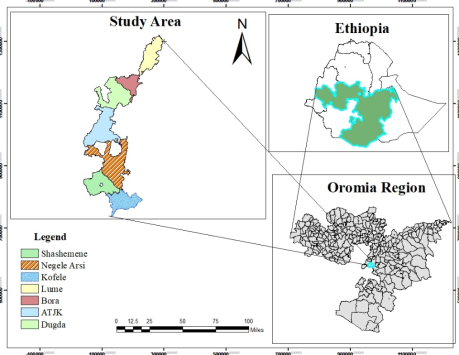
Wheat, maize, and rice 80% of global cereal production. Weeds pose a significant challenge for cereal crop cultivation, and effective weed control is essential for boosting yields. To better understand weed populations within agricultural systems, surveys are commonly conducted. Consequently, a comprehensive weed survey is vital for addressing current weed issues affecting major cereal crops. The primary objective of this survey was to assess and identify the prevalent weeds associated with wheat in the key production areas of the Central Rift Valley in Oromia. The weed survey took place in the East Shewa and West Arsi zones of the Oromia Regional State during the main cropping seasons from 2021 to 2023. It was carried out in 34 kebeles across 97 fields within seven districts of the two zones. Key parameters analyzed for each crop included density, frequency, relative frequency, and similarity index. Overall, in most crops and districts, annual broadleaf weeds were more prevalent than grasses and sedges. The Asteraceae family emerged as the most dominant, hosting the highest number of weed species across all assessed crops and fields, followed by the Poaceae and Amaranthaceae families. Notably, the composition of weeds was generally consistent across various districts, as indicated by the similarity index. The frequency of individual weed species in wheat fields varied, ranging from 1% to 91%, while the dominance values ranged from 0.71% to 21.92%. The most frequently encountered and dominant weeds included Galinsoga parviflora and Argemone mexicana L. for wheat, with Galinsoga parviflora being followed by Nicandra physalodes, Conyza bonariensis, and Commelina benghalensis.
| Published in | Journal of Chemical, Environmental and Biological Engineering (Volume 9, Issue 1) |
| DOI | 10.11648/j.jcebe.20250901.13 |
| Page(s) | 20-27 |
| Creative Commons |
This is an Open Access article, distributed under the terms of the Creative Commons Attribution 4.0 International License (http://creativecommons.org/licenses/by/4.0/), which permits unrestricted use, distribution and reproduction in any medium or format, provided the original work is properly cited. |
| Copyright |
Copyright © The Author(s), 2025. Published by Science Publishing Group |
Family, Distribution, Major Cereals, Frequency, Weed, Galensoga Palviflora
ZONE | Study area. | Altitude (ab.ms.l) | no of field assesed |
|---|---|---|---|
East Shewa | ATJK | 1647-1843 | 12 |
Dudga | 1657-1761 | 18 | |
Bora | 1595-1680 | 14 | |
Lume | 1664-1907 | 14 | |
West Arsi | Negelle Arsi | 1720-1921 | 18 |
Shashemanne | 2133-2169 | 15 | |
Kofele | 2398-2300 | 6 | |
Over all mean | 1595-2300 | 97 | |
no of kebele | 34 |
No. | Family | No. of species | No. | Family | No. of species |
|---|---|---|---|---|---|
1 | Asteraceae | 12 | 18 | Commelinaceae | 1 |
2 | Poaceae | 10 | 19 | Compositae | 1 |
3 | Solanaceae | 4 | 20 | Eragrostidae | 1 |
4 | Amaranthaceae | 3 | 21 | Fabaceae | 1 |
5 | Cyperaceae | 2 | 22 | Lamiaceae | 1 |
6 | Euphorbiaceae | 2 | 23 | Leguminosae | 1 |
7 | Polygonaceae | 2 | 24 | Malvaceae | 1 |
8 | Ranunculaceae | 2 | 25 | Onagraceae | 1 |
9 | Convolvulaceae | 1 | 26 | Oxalidaceae | 1 |
10 | Lamiaceae | 1 | 27 | Panicae | 1 |
11 | Papaveraceae | 1 | 28 | Portulacaceae | 1 |
12 | Polygonaceae | 1 | 29 | Primulaceae | 1 |
13 | Apiaceae | 1 | 30 | Rubiaceae | 1 |
14 | Boraginaceae | 1 | 31 | Trichocomaceae | 1 |
15 | Brassicaceae | 1 | 32 | Typhaceae | 1 |
16 | Caryophyllaceae | 1 | 33 | Verbanaceae | 1 |
17 | Cleomaceae | 1 | ⁻ | ⁻ | ⁻ |
Total | 62 |
Botaical Name | family | Category | Life Cycle | Density | Frequency | RD | FR | SD |
|---|---|---|---|---|---|---|---|---|
Agerantum conyoides | Asteraceae | Broad Leaf | Annual | 5.06 | 0.06 | 2.26 | 0.76 | 298.98 |
Amaranthus albus L. | Amaranthaceae | Broad Leaf | Annual | 4.00 | 0.01 | 1.79 | 0.13 | 1419.34 |
Amaranthus hybrid | Amaranthaceae | Broad Leaf | Annual | 3.97 | 0.04 | 1.78 | 0.50 | 352.37 |
Amaranthus spinosus | Amaranthaceae | Broad Leaf | Annual | 3.73 | 0.38 | 1.67 | 4.54 | 36.72 |
Anagallis arvensis | Primulaceae | Broad Leaf | Annual | 3.83 | 0.11 | 1.72 | 1.26 | 136.02 |
Argemone mexicana L. | Papaveraceae | Broad Leaf | Annual | 4.56 | 0.54 | 2.04 | 6.44 | 31.73 |
Aspergillus niger | Trichocomaceae | Sedge | Annual | 0.70 | 0.01 | 0.31 | 0.13 | 248.39 |
Avena fatua | Poaceae | Grassy | Annual | 4.27 | 0.30 | 1.91 | 3.53 | 54.06 |
Bidense pilosa | Asteraceae | Broad Leaf | Annual | 3.97 | 0.43 | 1.78 | 5.05 | 35.20 |
Brassica juncea | Brassicaceae | Broad Leaf | Annual | 3.55 | 0.12 | 1.59 | 1.39 | 114.37 |
Bromus tectorum | Poaceae | Grassy | Annual | 4.35 | 0.22 | 1.95 | 2.65 | 73.49 |
Chenopodium album | Asteraceae | Broad Leaf | Annual | 2.73 | 0.22 | 1.22 | 2.65 | 46.13 |
Cleome viscosa | Cleomaceae | Broad Leaf | Annual | 3.30 | 0.01 | 1.48 | 0.13 | 1170.96 |
Clotariaincana.L | Fabaceae | Broad Leaf | Annual | 0.30 | 0.01 | 0.13 | 0.13 | 106.45 |
Commelina benghalensis | Commelinaceae | Broad Leaf | Annual | 2.33 | 0.26 | 1.04 | 3.03 | 34.50 |
Convolvulus | Convolvulaceae | Broad Leaf | Pennerial | 1.70 | 0.01 | 0.76 | 0.13 | 603.22 |
Cosmos sulphureus | Asteraceae | Broad Leaf | Annual | 0.70 | 0.01 | 0.31 | 0.13 | 248.39 |
Cynodon dactlyon | Poaceae | Grassy | Pennerial | 5.62 | 0.22 | 2.52 | 2.65 | 95.03 |
Cynoglossum creticum | Boraginaceae | Broad Leaf | Biennial | 0.30 | 0.01 | 0.13 | 0.13 | 106.45 |
Cyprus esculentus | Cyperaceae | Sedge | Pennerial | 7.66 | 0.38 | 3.43 | 4.54 | 75.51 |
Cyprus rotundus | Cyperaceae | Sedge | Pennerial | 7.06 | 0.17 | 3.16 | 2.02 | 156.63 |
Datura stramonium | Solanaceae | Broad Leaf | Annual | 1.97 | 0.13 | 0.88 | 1.51 | 58.32 |
Delphinium leroyi | Ranunculaceae | Broad Leaf | Pennerial | 6.00 | 0.02 | 2.69 | 0.25 | 1064.51 |
Digitaria diagonalis | Poaceae | Grassy | Pennerial | 3.66 | 0.37 | 1.64 | 4.42 | 37.14 |
Echinochloa esculenta | Poaceae | Grassy | Pennerial | 2.63 | 0.09 | 1.18 | 1.01 | 116.43 |
Eleusine indica | Poaceae | Grassy | Pennerial | 2.99 | 0.11 | 1.34 | 1.26 | 106.06 |
Eragrostis Cilianen | Eragrostidae | Grassy | Annual | 4.20 | 0.33 | 1.88 | 3.91 | 48.08 |
Euphorbia esula | Euphorbiaceae | Broad Leaf | Pennerial | 2.33 | 0.21 | 1.04 | 2.52 | 41.30 |
Euphorbia hirta | Euphorbiaceae | Broad Leaf | Pennerial | 0.70 | 0.01 | 0.31 | 0.13 | 248.39 |
Foeniculum vulgare Mill | Apiaceae | Broad Leaf | Pennerial | 5.00 | 0.01 | 2.24 | 0.13 | 1774.18 |
Galensoga palviflora | Asteraceae | Broad Leaf | Annual | 6.99 | 0.67 | 3.13 | 7.95 | 39.35 |
Galium spurium | Rubiaceae | Broad Leaf | Annual | 3.93 | 0.05 | 1.76 | 0.63 | 279.14 |
Gozotia abisinica | Asteraceae | Broad Leaf | Annual | 3.28 | 0.24 | 1.47 | 2.90 | 50.61 |
Hieracium snowdoniense | Asteraceae | Broad Leaf | Annual | 6.59 | 0.17 | 2.95 | 2.02 | 146.15 |
Leersia hexandra | Poaceae | Grassy | Pennerial | 5.70 | 0.01 | 2.55 | 0.13 | 2022.57 |
Leucas aspera | Lamiaceae | Broad Leaf | Annual | 3.18 | 0.10 | 1.42 | 1.14 | 125.34 |
Malva neglecta | Malvaceae | Broad Leaf | Annual | 2.70 | 0.01 | 1.21 | 0.13 | 958.06 |
Nicandra physlodes | Solanaceae | Broad Leaf | Annual | 3.03 | 0.51 | 1.36 | 6.06 | 22.38 |
Oenothera biennis | Onagraceae | Broad Leaf | Biennial | 7.20 | 0.01 | 3.22 | 0.13 | 2554.82 |
Oxalis acetosella | Oxalidaceae | Broad Leaf | Pennerial | 3.73 | 0.05 | 1.67 | 0.63 | 264.94 |
Oxygonum | Polygonaceae | Broad Leaf | Pennerial | 0.70 | 0.01 | 0.31 | 0.13 | 248.39 |
Parthiunium Hysterophoros | Asteraceae | Broad Leaf | Annual | 2.87 | 0.14 | 1.29 | 1.64 | 78.39 |
Pennisetum setaceum | Poaceae | Grassy | Pennerial | 5.77 | 0.40 | 2.58 | 4.80 | 53.90 |
Phyla nodiflora | Verbanaceae | Broad Leaf | Pennerial | 0.70 | 0.01 | 0.31 | 0.13 | 248.39 |
Physalis angulata | Solanaceae | Broad Leaf | Annual | 1.70 | 0.01 | 0.76 | 0.13 | 603.22 |
Polygonum arenastrum | Polygonaceae | Broad Leaf | Pennerial | 3.19 | 0.07 | 1.43 | 0.88 | 161.73 |
Portulaca oleracea | Portulacaceae | Broad Leaf | Pennerial | 3.25 | 0.04 | 1.46 | 0.50 | 288.30 |
Ranunculus asiaticus | Ranunculaceae | Broad Leaf | Pennerial | 8.33 | 0.02 | 3.73 | 0.25 | 1478.48 |
Rumex crispus | Polygonaceae | Broad Leaf | Pennerial | 0.30 | 0.01 | 0.13 | 0.13 | 106.45 |
salvia officinalis | Lamiaceae | Broad Leaf | Pennerial | 4.08 | 0.04 | 1.83 | 0.50 | 362.23 |
Setaria pumila | Poaceae | Grassy | Annual | 7.03 | 0.13 | 3.15 | 1.51 | 207.81 |
Setria verticelata | Panicae | Grassy | Annual | 3.61 | 0.31 | 1.62 | 3.66 | 44.21 |
Silybum marianum | Asteraceae | Broad Leaf | Biennial | 1.76 | 0.06 | 0.79 | 0.76 | 104.04 |
Solanum nigrum | Solanaceae | Broad Leaf | Annual | 3.00 | 0.02 | 1.34 | 0.25 | 532.25 |
Sonchus oleraceus | Compositae | Broad Leaf | Annual | 4.33 | 0.05 | 1.94 | 0.63 | 307.52 |
Spergula arvensis | Caryophyllaceae | Broad Leaf | Annual | 0.70 | 0.01 | 0.31 | 0.13 | 248.39 |
Tagetes minuta | Asteraceae | Broad Leaf | Annual | 9.72 | 0.02 | 4.35 | 0.25 | 1724.90 |
Themeda triandra | Poaceae | Grassy | Perennial | 5.17 | 0.02 | 2.31 | 0.25 | 916.66 |
Typha angustifolia | Typhaceae | Grassy | Perennial | 2.67 | 0.04 | 1.19 | 0.50 | 236.56 |
Vigna luteola (Jacq.) Benth. | Leguminosae | Broad Leaf | Perennial | 0.30 | 0.01 | 0.13 | 0.13 | 106.45 |
Xanthium spinosum | Asteraceae | Broad Leaf | Annual | 1.95 | 0.10 | 0.87 | 1.14 | 76.91 |
Xanthium strumarium | Asteraceae | Broad Leaf | Annual | 2.69 | 0.24 | 1.20 | 2.90 | 41.51 |
District | ATJK | Dugda | Bora | Lume | Negelle A | Shashe | Kofele |
|---|---|---|---|---|---|---|---|
ATJK | 100.00% | 66.93% | 61.76% | 39.58% | 63.16% | 34.88% | 53.78% |
Dugda | 100.00% | 65.00% | 43.40% | 48.90% | 33.33% | 44.20% | |
Bora | 100.00% | 46.67% | 63.63% | 35.72% | 100.00% | ||
Lume | 100.00% | 42.22% | 29.10% | 38.30% | |||
Negelle A | 100.00% | 44.74% | 100.00% | ||||
Shashe | 100.00% | 48.65% | |||||
Kofele | 100.00% |
MASL | Meter Above Sea Level |
ATJK | Adami Tulu Jido Kombolcha |
| [1] | Dessie A. Cereal crops research achievements and challenges in Ethiopia. International Journal of Research and Review. 2018; 5(9): 116-122. |
| [2] | Central Statistical Authority of Ethiopia (CSA).2016/17. Report on area and production of major crops, private peasant holdings, meher season, Addis Ababa. |
| [3] | Lopez-Granados F. 2011. Weed detection for site-specific weed management: mapping and real-time approaches. Weed Research, 51: 1- 11. m. |
| [4] | Shahzhad F, N Lixiao, R Amjadur, C Chang, W Chao, S Shah, H Jianliang. 2012. Weed control and yield attributes against postemergence herbicides application in wheat crop, Punjab, Pakistan. |
| [5] | Reddy TY and Reddi GHS. 2011. Principles of Agronomy. Kalyani Publishers, Noida, India. P. 527. |
| [6] | Javaid AR, Bajwa R, Rabbani N and Anjum T. 2007. Comparative tolerance of rice (Oryza sativa L.) genotypes to purple nutsedge (Cyperus rotundus L.) allelopathy. Allelopathy Journal, 20(1), pp. 157-166. |
| [7] | Palumbo JC (2013). Insect weed interactions in vegetable crops. VegIPM Update 4(13): 1-3. |
| [8] | Tena E, Hiwet AG, Dejene M (2012) Quantitative and Qualitative Determination of Weeds in Cotton-Growing Areas of Humera and Metema, Northwestern Ethiopia. Ethioian Journal of Applied Science Technology 3(1): 57- 69. |
| [9] | Upadhyay RK, Baksh H, Patra DD (2011). Integrated weed management of medicinal plants In India. International Journal of Medinal and Aromatic Plants 1(2): 51-56. |
| [10] | Parker C and Fryer JD. 1975. Weed control problems causing major reductions in world food supplies (No. 76-120049. CIMMYT.). |
| [11] | Mohammad, A., Baghestani, M. A., Z and, E., Soufizadeh, S., Bagherani, N. and R. Deihimfard. 2007. Weed control and wheat (Triticum aestivum L.) yield under application of 2, 4-D plus carfentrazoneethyl and florasulam plus flumetsulam. Crop Protection, 26(12): 1759-1764. |
| [12] | Akobundu IO. 1987 Sugarcane. Weed Science in the Tropics: Principles and Practices (IO Akobundu, ed.). John Wiley and Sons, New York, pp. 414-416. |
| [13] | Chikoye D, Schulz S, Ekeleme F (2004). Evaluation of integrated weed management practices for maize in the northern Guinea Savanna of Nigeria. Crop Protection 23: 895-900. |
| [14] | Vissoh PV, Gbehounou G, Ahantchede A, Kuyper TW, Rolling NG (2004). Weeds as agricultural constraint to farmers in Benin: result of a Diagnostic study. NJAS Wageningen. Journal of Life Science 52: 308-329.003000.0. |
| [15] | Uddin MK, Juraimi AS, Ismail MR and Brosnan JT. 2010. Characterizing weed populations in different turfgrass sites throughout the Klang Valley of Western Peninsular Malaysia. Weed Technology, 24(2), pp. 173-181. |
| [16] | Jibat M, Getachew W, Getu A, Kifelew H (2019). Survey and Identification of Major Weeds of Seeds Spice in Ethiopia. Plant Pathol Microbiol; 10: 477. |
| [17] | Thomas AG (1985). Weed survey System used in Saskatchewan for cereal and oilseed crops. Weed Science 33: 34-43. |
| [18] | Abay Guta, Getu Abera. Assessments and Identification of Major Weed of Hot Pepper (Capsicum annuum L.) in West Shoa and East Wollega Zones, Ethiopia. Journal of Plant Sciences. Vol. 10, No. 2, 2022, pp. 51-56. |
| [19] | Chhokar RS and Malik RK (2002). Isoproturon resistant Phalaris minor and its response to alternate herbicides. Weed Technology 16: 116-123. |
| [20] | Anderson RL and Beck DL (2007). Characterizing weed communities among various rotations in central south Dakota. Weed Technology 21: 76-79. |
| [21] | Dixit A, Gogoi AK and Varshney JG (2008b). Weed Atlas- District-wise distribution pattern of major weed flora in prominent crops. Vol II, National Research Centre for Weed Science, Jabalpur, India, Pp 88. |
| [22] | Megersa K., Geleta G., Kasa M., (2017) Qualitative and Quantitative Assessment of Weed in the Major Wheat Growing Areas of Western Oromia Region, Ethiopia Vol. 7 No. 19, 2017 ISSN 2224-3186 (Paper) ISSN 2225-0921 (Online). |
APA Style
Tesfaye, G., Begna, F., Longle, A. (2025). Assessment and Identification of Major Weeds on Wheat (Triticum aestivum) in East Shewa and West Arsi, Zones, Oromia. Journal of Chemical, Environmental and Biological Engineering, 9(1), 20-27. https://doi.org/10.11648/j.jcebe.20250901.13
ACS Style
Tesfaye, G.; Begna, F.; Longle, A. Assessment and Identification of Major Weeds on Wheat (Triticum aestivum) in East Shewa and West Arsi, Zones, Oromia. J. Chem. Environ. Biol. Eng. 2025, 9(1), 20-27. doi: 10.11648/j.jcebe.20250901.13
AMA Style
Tesfaye G, Begna F, Longle A. Assessment and Identification of Major Weeds on Wheat (Triticum aestivum) in East Shewa and West Arsi, Zones, Oromia. J Chem Environ Biol Eng. 2025;9(1):20-27. doi: 10.11648/j.jcebe.20250901.13
@article{10.11648/j.jcebe.20250901.13,
  author = {Gobena Tesfaye and Feyisa Begna and Adisu Longle},
  title = {Assessment and Identification of Major Weeds on Wheat (Triticum aestivum) in East Shewa and West Arsi, Zones, Oromia
},
  journal = {Journal of Chemical, Environmental and Biological Engineering},
  volume = {9},
  number = {1},
  pages = {20-27},
  doi = {10.11648/j.jcebe.20250901.13},
  url = {https://doi.org/10.11648/j.jcebe.20250901.13},
  eprint = {https://article.sciencepublishinggroup.com/pdf/10.11648.j.jcebe.20250901.13},
  abstract = {Wheat, maize, and rice 80% of global cereal production. Weeds pose a significant challenge for cereal crop cultivation, and effective weed control is essential for boosting yields. To better understand weed populations within agricultural systems, surveys are commonly conducted. Consequently, a comprehensive weed survey is vital for addressing current weed issues affecting major cereal crops. The primary objective of this survey was to assess and identify the prevalent weeds associated with wheat in the key production areas of the Central Rift Valley in Oromia. The weed survey took place in the East Shewa and West Arsi zones of the Oromia Regional State during the main cropping seasons from 2021 to 2023. It was carried out in 34 kebeles across 97 fields within seven districts of the two zones. Key parameters analyzed for each crop included density, frequency, relative frequency, and similarity index. Overall, in most crops and districts, annual broadleaf weeds were more prevalent than grasses and sedges. The Asteraceae family emerged as the most dominant, hosting the highest number of weed species across all assessed crops and fields, followed by the Poaceae and Amaranthaceae families. Notably, the composition of weeds was generally consistent across various districts, as indicated by the similarity index. The frequency of individual weed species in wheat fields varied, ranging from 1% to 91%, while the dominance values ranged from 0.71% to 21.92%. The most frequently encountered and dominant weeds included Galinsoga parviflora and Argemone mexicana L. for wheat, with Galinsoga parviflora being followed by Nicandra physalodes, Conyza bonariensis, and Commelina benghalensis.
},
 year = {2025}
}
TY  - JOUR
T1  - Assessment and Identification of Major Weeds on Wheat (Triticum aestivum) in East Shewa and West Arsi, Zones, Oromia

AU  - Gobena Tesfaye
AU  - Feyisa Begna
AU  - Adisu Longle
Y1  - 2025/02/26
PY  - 2025
N1  - https://doi.org/10.11648/j.jcebe.20250901.13
DO  - 10.11648/j.jcebe.20250901.13
T2  - Journal of Chemical, Environmental and Biological Engineering
JF  - Journal of Chemical, Environmental and Biological Engineering
JO  - Journal of Chemical, Environmental and Biological Engineering
SP  - 20
EP  - 27
PB  - Science Publishing Group
SN  - 2640-267X
UR  - https://doi.org/10.11648/j.jcebe.20250901.13
AB  - Wheat, maize, and rice 80% of global cereal production. Weeds pose a significant challenge for cereal crop cultivation, and effective weed control is essential for boosting yields. To better understand weed populations within agricultural systems, surveys are commonly conducted. Consequently, a comprehensive weed survey is vital for addressing current weed issues affecting major cereal crops. The primary objective of this survey was to assess and identify the prevalent weeds associated with wheat in the key production areas of the Central Rift Valley in Oromia. The weed survey took place in the East Shewa and West Arsi zones of the Oromia Regional State during the main cropping seasons from 2021 to 2023. It was carried out in 34 kebeles across 97 fields within seven districts of the two zones. Key parameters analyzed for each crop included density, frequency, relative frequency, and similarity index. Overall, in most crops and districts, annual broadleaf weeds were more prevalent than grasses and sedges. The Asteraceae family emerged as the most dominant, hosting the highest number of weed species across all assessed crops and fields, followed by the Poaceae and Amaranthaceae families. Notably, the composition of weeds was generally consistent across various districts, as indicated by the similarity index. The frequency of individual weed species in wheat fields varied, ranging from 1% to 91%, while the dominance values ranged from 0.71% to 21.92%. The most frequently encountered and dominant weeds included Galinsoga parviflora and Argemone mexicana L. for wheat, with Galinsoga parviflora being followed by Nicandra physalodes, Conyza bonariensis, and Commelina benghalensis.

VL  - 9
IS  - 1
ER  -
Adami Tullu Agricultural Research Center, Ziway, Ethiopia
Adami Tullu Agricultural Research Center, Ziway, Ethiopia
Adami Tullu Agricultural Research Center, Ziway, Ethiopia

Information



 Share This Article
 Twitter
 Linked In
 Facebook
 Copy
Copy Download